VPP Product Update: Introducing FCR-D Up and Down Capability for PV Assets
FCR-D — Frequency Containment Reserve for Disturbances — is a Nordic ancillary service that pays grid assets to automatically adjust output when grid frequency deviates from its 50 Hz target. Historically, participating meant owning a battery. This update changes that for solar.
At Fusebox, we’re excited to announce the dynamic evolution of our existing functionality within our virtual power plant (VPP) platform. Our enhanced FCR-D up and down capability now applies seamlessly to PV panels through inverters, allowing our platform to dynamically calculate and dispatch the required DIF (power change) values directly to the controller. With this advancement, PV park owners in the Nordic ancillary services market can engage more actively, enjoying increased flexibility and functionality without the need for additional battery storage.
Efficient setpoint calculation for PV assets
This new feature lets us factor in current weather conditions and power output, allowing precise setpoint adjustments to connect your PV park smoothly to the FCR-D service for optimal performance and flexibility.
We developed a model using a ~1.4MW PV unit in our test environment to visualise this control mechanism. Just before the FCR-D event, this PV unit was generating around 1.3MW. This baseline calculates precise setpoints, ensuring optimised performance during frequency regulation events.
Direct FCR-D support for PV parks
Fusebox can now offer FCR-D support directly to PV panels in the Nordic countries. By connecting our controller to PV inverters, we enable PV park owners to adjust output levels based on FCR-D signals from the local transmission system operator (TSO). This development allows PV parks to participate directly in the ancillary market without needing additional battery storage: a significant cost-saving advantage. Our new FCR-D functionality has been rigorously tested and passed all real-life asset tests.
Understanding FCR-D activation
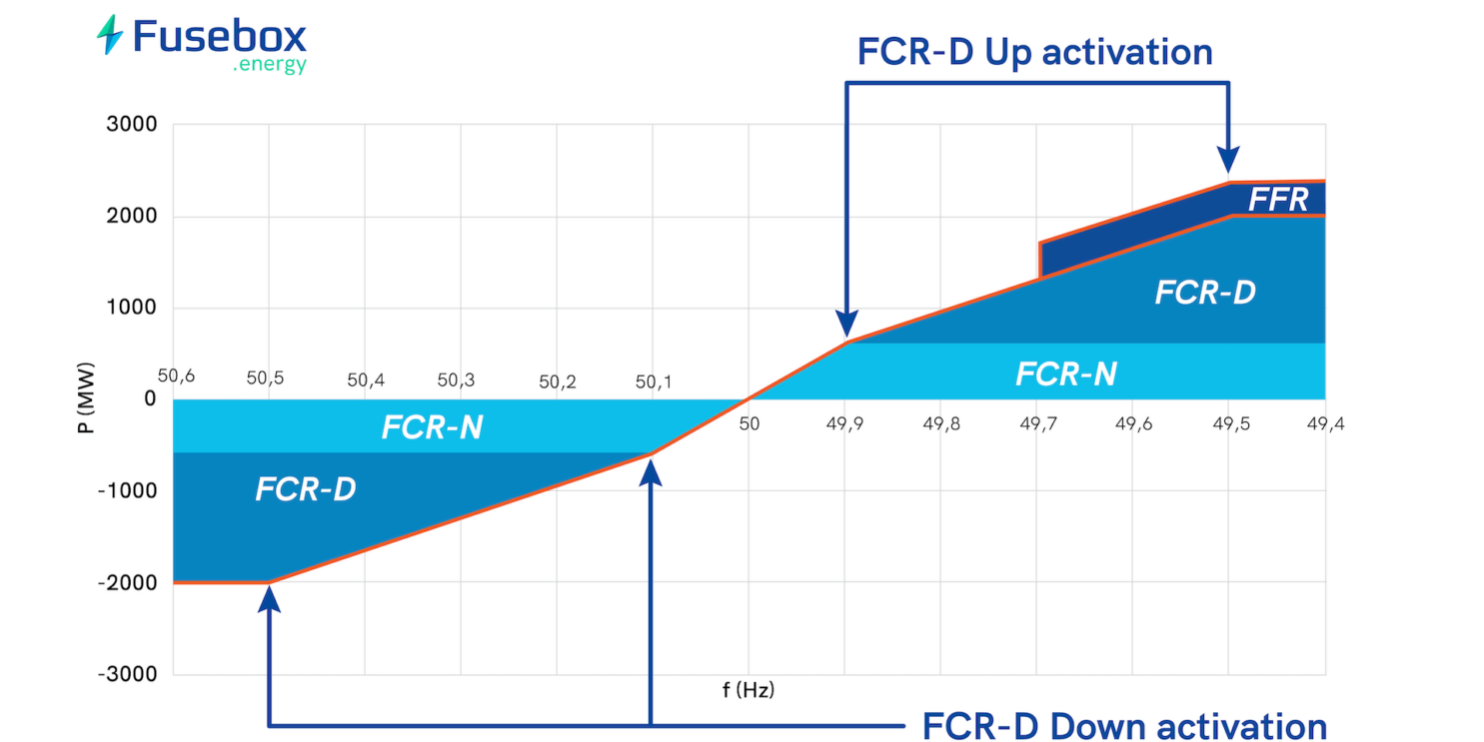
As illustrated in the accompanying graph, FCR-D control activates when the grid frequency deviates by ±0.1 Hz from the nominal 50 Hz (i.e., at 49.9 Hz or 50.1 Hz). The product is divided into two symmetrical components:
- FCR-D Up (50.1 to 50.5 Hz): upregulation product where power plants increase production, and loads reduce consumption.
- FCR-D Down (49.9 to 49.5 Hz): downregulation product where power plants decrease production, and loads increase consumption.
Our VPP system calculates setpoints as a difference between the necessary activation quantity and the meter value just before the FCR-D event.
Key technical details
- Activation speed: 86% in 7.5 seconds
- Market structure: hourly market with capacity payment based on availability
- Minimum bid size: 1 MW
- Pricing: Nordic FCR-D prices have fallen significantly as more capacity has entered the market. Fingrid’s own 2026 yearly-market procurement update confirms the trend, noting prices “will decrease in all FCR reserves” — check Fingrid’s published rates directly for current hourly and yearly-market levels before modelling revenue for your asset.
Unlocking new opportunities for PV assets
With FCR-D integration in the Nordics, PV assets can now join frequency regulation, opening up new revenue streams and boosting flexibility. Fusebox’s solution provides automatic, local frequency control, making it an easy, efficient addition to PV parks.
This update reflects our commitment to innovative, cost-effective solutions that help integrate renewables into the grid.
Curious what FCR-D participation could look like for your PV assets? Talk to Fusebox →