Article · 21 November 2026
Our busiest pace on the Claude API: ~$14K a month, with caching
At our busiest day's pace, our coding agents would cost about $14K a month on the Claude API, and that is after an 84% discount from prompt caching. Why agents read so much, and when a plan is the better deal.

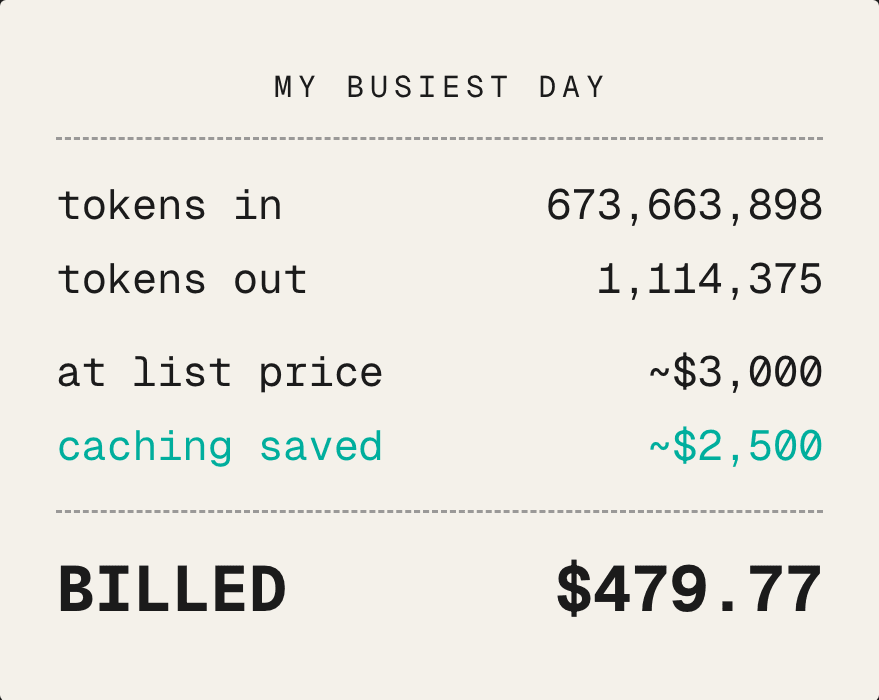
What do one developer's AI coding agents cost when every token is billed? Sergey, our CTO, ran his on the Claude API alone for 18 days, so you don't have to, and the Claude Console counted every token. On his busiest day the agents read about 674 million tokens and wrote about 1 million. At list price, that day was worth about $3,000. The bill said $479.77. Caching saved the day.
But that's only one day. If every day was like that one, the API would cost about $14,000 a month, with caching on. That is far above a $100 or $200 Claude plan. Why pay API prices when a plan is so much cheaper? Because a plan never shows what agent work really costs, and that number is what tells you whether a plan or the API is your better deal. He paid for it; here it is.
Below: why agents read so much, how caching got an 84% discount on the bill, four rules that keep a cache hitting, and how to tell whether a plan or the API is your better deal.
The numbers
- The busiest day: 673,663,898 tokens in, 1,114,375 out, $479.77 billed: $431.90 on Claude Opus 5, $47.25 on Claude Sonnet 5, the rest under a dollar.
An agent pays for what it reads
For every token the agents wrote, they read about 600. Each step of a coding agent sends the whole context again: the system prompt (the standing instructions), the repository's rules, the open files and the conversation so far. It writes a few lines of code and starts the next step by sending all of it once more.
Output costs five times as much as input per token, so it looks like the expensive part. It is not: on the busiest day output came to about $28 of the $3,000 list price. What an agent costs is what it reads, and reading is what caching makes cheap.
What caching changes
With caching on, the API keeps the opening part of a request, its prefix, and when the next request starts with the same bytes it charges 90 to 95% less than the input price for them (how prompt caching works). Writing the prefix into the cache costs a little more than a normal read; the prices are Anthropic's published list:
| per million tokens | input | cache write (5 min) | cache read | output |
|---|---|---|---|---|
| Claude Opus 5.5 | $4 | $5 | $0.20 | $20 |
| Claude Opus 5 | $5 | $6.25 | $0.50 | $25 |
| Claude Sonnet 5.5 | $2 | $2.50 | $0.10 | $10 |
| Claude Sonnet 5 | $2 | $2.50 | $0.20 | $10 |
His agents ran on Claude Opus 5 and Claude Sonnet 5; the 5.5 rows are the current models, where a cached read is 95% off the input price instead of 90%. On Claude Opus 5 the first send of a prefix costs 25% more than input and every re-send within five minutes 90% less, so by the second send caching is already 32% cheaper: $6.75 against $10 per million tokens.
How much of the day came from the cache? The bill tells you. Claude Opus 5 carried 90% of the bill, so price the whole day at Opus rates. If all 674 million input tokens had been cache reads, they would cost $337. Output adds about $28. The other $115 or so pays for what was not a cache read, mostly cache writes: some 20 million tokens. So about 97% of what the agents read came from the cache; Sonnet's cheaper tokens pull the real share somewhat lower.
How to keep the cache hitting
Claude Code caches for you, on a plan or on the API, so there is nothing to set. This is for agents and tools you build on the API yourself:
- The cache matches a prefix, byte for byte. Tools come first, then the system prompt, then the messages. Change one byte near the start, a timestamp in the system prompt or a reordered tool list, and everything after it is read at full price.
- Append, never edit. Add new messages at the end. Rewriting an earlier turn breaks the cache from that turn on.
- Pick the time to live by the gaps. A 5-minute entry stays warm while requests come less than 5 minutes apart, and each read resets the timer. When a person reviews between agent turns and the gaps run longer, a 1-hour entry costs $10 per million tokens to write on Claude Opus 5, while writing a 5-minute entry twice costs $12.50.
- Check it. Every response reports
cache_read_input_tokens. If it stays at zero on repeated requests, something in the prefix changes every time.
Subscription or API: the break-even
On Claude's pricing page, the $200 Ultra plan is $6.67 a day and the $100 Max plan $3.33. If your agents' API days would cost more than that and your work fits inside the plan's weekly limit, the plan is cheaper. His busiest day, with caching, cost as much as 72 days of the Ultra plan.
To see your own daily number, on a plan or on the API, run the open-source ccusage. It reads Claude Code's local logs and prices each day at API rates:
$ npx ccusage claude daily

┌────────────┬──────────┬────────────┐
│ Date       │ Models   │ Cost (USD) │
├────────────┼──────────┼────────────┤
│ 2026-09-16 │ opus-5   │    $453.32 │
│ 2026-09-21 │ opus-5   │    $485.81 │
│ 2026-10-12 │ opus-5   │    $442.15 │
└────────────┴──────────┴────────────┘
The API is the right choice where a plan does not fit: agents running on a server with no person signed in, a team that needs one budget and one bill, or work that must go on after a plan's weekly limit is reached. There, caching decides whether the bill is $479.77 or $3,000 for the same day.
- Chat a few times a day: the $20 Pro plan is enough.
- Coding with an agent most days, alone: the $100 Max or $200 Ultra plan.
- Agents on a server, a team budget, or past the weekly limit: the API, with a stable prefix.
In short
- An agent's bill is its input: it reads about 600 tokens for each one it writes.
- Caching cut the busiest day from about $3,000 to $479.77: an 84% discount.
- Keep the prefix stable and append only, or you pay full price again.
- Above $3.33 to $6.67 of API use a day, a plan is cheaper, as long as your work fits inside its weekly limit.
Next: how he uses two subscriptions side by side, so a day's work keeps going past a weekly limit without losing its context.
Part of what those agents re-read, every step, is the company's own context: its rules, documents and decisions. We put that same context behind Fusie, the AI assistant every team at Fusebox works with.
Sources: Claude API pricing, how prompt caching works, Claude Code costs, Claude plans. The figures are from the Claude Console.