AI in Energy Management: Hype or Gripe?
Let’s talk about the very buzzword on everyone’s lips nowadays: the mighty AI.
At Fusebox, we feel its presence every day, whether it’s helping streamline communications, acting as a powerful research tool, or assisting with code cleaning and product development. The capabilities of large language models (LLMs) seem to stretch far and wide. But beyond the hype, is AI truly beneficial in the energy sector? Let’s dig a little deeper.
From ageing energy infrastructure to the green transition
To understand the challenge ahead, let’s take a quick look at Europe’s energy landscape. The good news is that our grid has remained highly reliable. You guessed it, there is a “but.” About 40% of Europe’s power distribution networks are over 40 years old, built for a centralised energy system where power flowed one way from coal and nuclear plants to consumers.
Today, the issue isn’t just rising energy demand but the decentralisation of energy production. Distributed energy resources (DERs) like rooftop solar, batteries, and EV chargers inject power into the grid from countless points, making stability harder to maintain. Consumers feel the results through ever-increasing price volatility and negative electricity prices.
Grid congestion is another growing concern. Limited transmission capacity forces countries like Germany to curtail renewable energy, while ageing distribution networks struggle to handle bidirectional power flows, causing voltage fluctuations, overloads, and inefficiencies.
For the green transition to work, and for consumers not to pay many times higher prices for it, a solution is needed.
From no data to overload
Fifty years ago, before digitalisation, grid operators had the opposite problem. They didn’t have enough real-time data. Power flows were mostly estimated, and monitoring was limited to a few key points. Today, the situation has flipped. With smart meters, distributed energy resources, and Internet of Things (IoT) sensors everywhere, utilities are now collecting more data than ever, far beyond what traditional grid management systems were built to handle.
To put it into perspective, by 2030, 250 million smart meters in Europe reporting every 30 minutes will generate around 4.4 trillion readings per year. Add to that millions of EV chargers updating power levels every few minutes and thousands of renewable plants streaming performance metrics, and the data challenge becomes clear. The energy sector’s data volume is still a small fraction of the roughly 175 zettabytes of global data IDC projected the world would generate annually by 2025, but the real challenge was never the sheer volume. It’s making sense of it all in real time.
More data should make grid management easier, but without advanced analytics and AI-driven aggregation, it does the opposite. Grid operators are stuck reacting to imbalances instead of preventing them. AI is no longer optional. It is the only way to transform this flood of data into actionable insights, making energy management smarter, faster, and more stable.
Do we need AI?
The challenge is no longer collecting data. It is processing and using it in real time. The problem is that power utilities do not have direct access to real-time measurement data from distribution system operators (DSOs). Without it, they cannot accurately profile consumer consumption and production patterns or make AI-driven decisions that actually improve operations. AI thrives on high-quality, real-time data, but if utilities only have access to historical data, its potential is wasted.
This problem is becoming more expensive. The green transition relies on intermittent renewable resources, making it harder for utilities to balance supply and demand. A decade ago, imbalance costs for large Nordic power utilities were around three euros per megawatt-hour. Three years later, they had jumped to 25 euros. By early 2025, estimates put them as high as 60 euros, showing just how much balance responsible parties (BRPs) were struggling with this issue even then.
How Fusebox solves this challenge
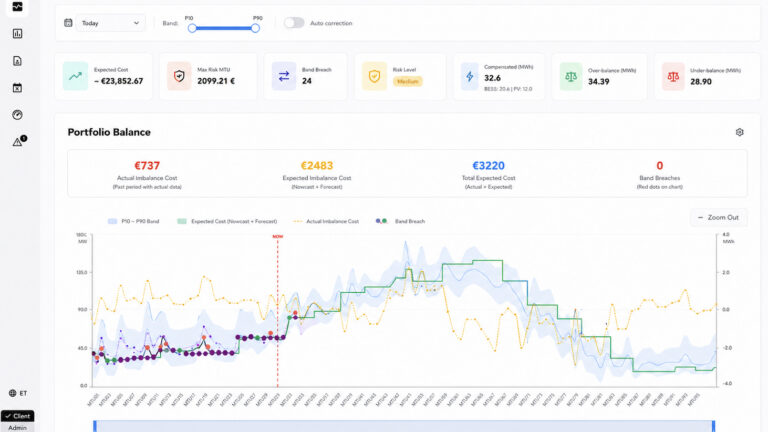
At Fusebox, we provide a way to bridge this gap. Our platform allows asset owners and power utilities to connect flexible assets directly to our cloud, giving them real-time, one-second interval readings from the asset. This is a two-way connection. We do not just collect data, we also send control signals back to the assets, allowing for instant optimisation.
Our machine learning models analyse this real-time data, combining immediate measurements with historical patterns to optimise energy use. Unlike traditional systems that follow fixed rules, our AI continuously learns and adapts. It forecasts price shifts, consumption trends, and renewable generation to help utilities and asset owners reduce their imbalance costs and maximise the value of their flexibility.
AI in energy: hype or real help?
So, is AI really changing energy management? The answer is both yes and no.
On one hand, AI is undeniably a game-changer. It has the potential to predict imbalances before they happen, optimise battery storage, and automate decisions that used to take hours. It can make grid operations smarter, faster, and more cost-efficient.
On the other hand, AI is only as good as the data it works with. If power utilities do not have access to real-time data, AI can only analyse the past, which limits its ability to provide real value. Poor data leads to poor predictions. Implementing AI also requires investment, expertise, and a shift in traditional ways of working. While AI can automate decision-making, human oversight is still essential.
Ignoring AI is not an option, though. The energy system is becoming too complex for traditional approaches to keep up. Whether it’s reducing price volatility, improving grid stability, or making renewable energy more efficient, AI is proving itself a necessary tool. The key is not just using AI, but making sure it has the data it needs to deliver real impact.
Curious what AI-driven optimisation could do for your own flexibility portfolio? Talk to Fusebox →