Integrating Fusebox into Existing Client Platforms to Create Novel Energy Flexibility Solutions
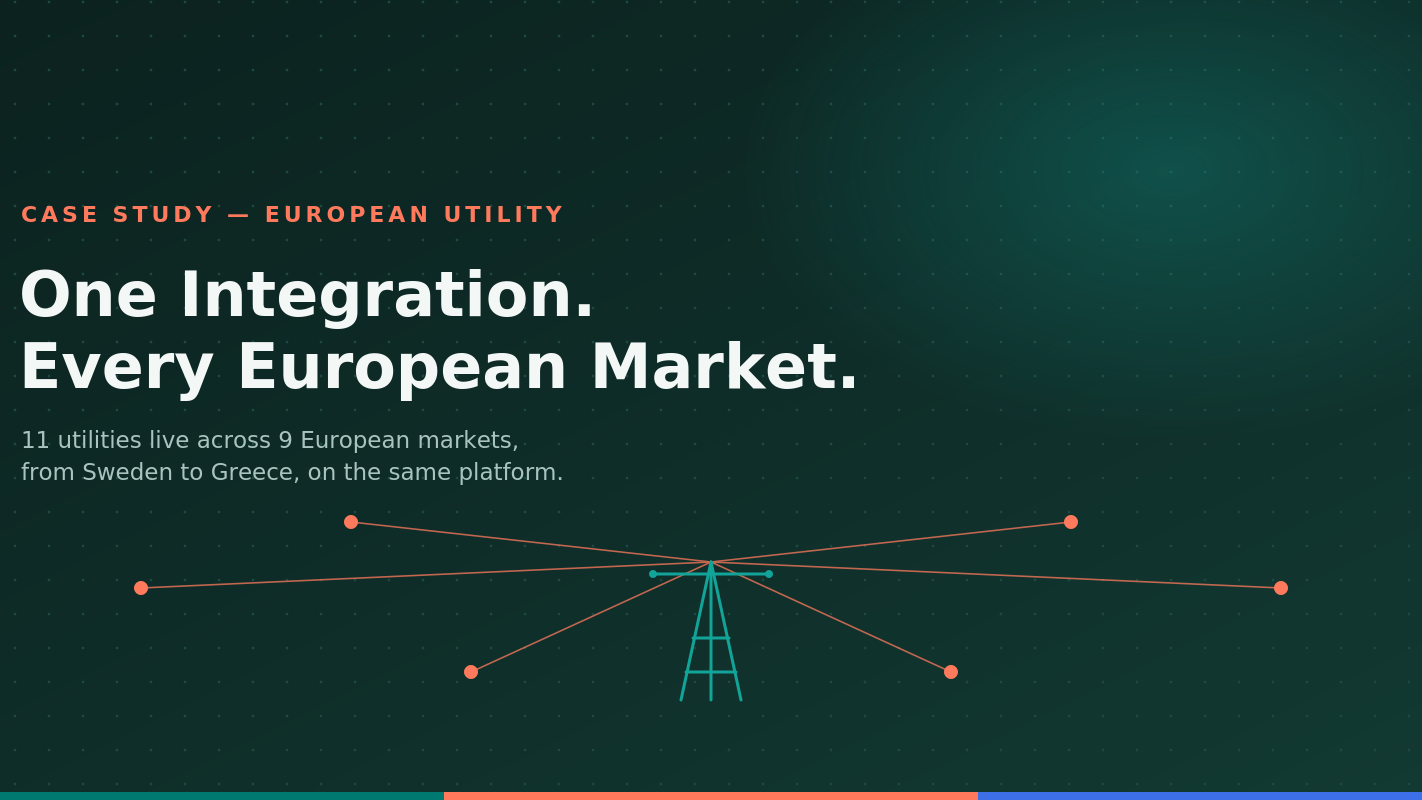
Fusebox has built the same integration pattern for utility-type clients across nine European markets: Sweden, Finland, Estonia, Latvia, Lithuania, Romania, Bulgaria, Greece, and Slovenia, the most recent addition to that footprint. Across those markets, Fusebox has delivered live VPP deployments for 13 utilities. The largest single portfoli connected to our platform is around 300 MW of flexible capacity, with an ambition to grow up to 2 GW within a couple of years.
The client’s goal is to enhance their ability to manage assets and participate in energy markets, with a focus on communication, bidding, and asset control logic. Their aim was to optimise data exchange, asset scheduling, and pricing logic while ensuring compliance with international energy communication standards and seamless integration with TSO infrastructure.
Solution: Fusebox’s energy flexibility platform integration
This kind of integration comes down to three layers in practice: real-time data and control down to the asset, bids and telemetry up to the TSO, and both layers staying synchronised without asking the client to rebuild anything they already run.
At the asset layer, Fusebox supports three integration paths, chosen per site rather than forced uniformly across a portfolio: a Fusebox-supplied controller connected via Modbus RTU/TCP or relays; a client-owned controller integrating directly with the Fusebox MQTT broker, device-based access credentials, and per-device access control lists; or, where a site already runs a SCADA layer, direct protocol-level exchange over IEC 60870-5-104. All three converge on the same platform logic upstream, so a utility with a mixed fleet, some sites on modern SCADA, others on older relay-based control, doesn’t need a different tool for each one.
At the TSO layer, Fusebox builds up bidding, activation, and settlement data exchange channel. The specific ancillary products vary by country: manual frequency restoration reserve (mFRR), automatic frequency restoration reserve (aFRR), frequency containment reserve (FCR), and frequency containment reserve for normal operation (FCR-N) and for disturbances (FCR-D) in the Nordics. The platform’s bidding logic is configured per market rather than applying one fixed template everywhere.
The project itself followed Fusebox’s standard onboarding sequence: project planning and scoping, tenant creation, pilot site integration, TSO integration (often run in parallel with asset onboarding), portfolio building, and joint prequalification testing with the TSO before going live.
Key development steps:
- Establishing communication protocols. Creating the necessary communication infrastructure between the client’s systems and the Fusebox platform.
- Asset command and measurement logic. Building the data flows that transmit asset commands, gather real-time telemetry, and report asset performance back to both platforms.
- TSO integration and prequalification. Connecting the Fusebox platform to the regional TSO and running the joint technical tests required before any asset can bid into the ancillary market.
- Trading desk or ETRM integration. Fusebox has various API endpoints for the market position schedules, production forecast delivery, go-to-market price and others.
Key results
- Enhanced market participation: the client now participates more effectively in ancillary energy markets, increasing market reach and revenue generation.
- Real-time asset control: the system ensures seamless communication and real-time data exchange between assets, TSOs, and energy management systems, allowing the client to optimise asset usage for energy flexibility.
- Efficient bidding and scheduling: the integrated platform streamlined bidding and scheduling using merit-order activation logic, improving accuracy and speed in market operations while ensuring compliance with regulatory requirements.
- Platform reliability: the integration runs under Fusebox’s standard 99.0% monthly uptime commitment, measured from the moment an outage is logged in the system to full service restoration.
Conclusion
The collaboration between Fusebox and the client successfully delivered an integrated solution for participating in energy markets, optimising asset management, and ensuring efficient communication. It’s also a pattern, not a one-off: the same architecture, protocol-agnostic at the asset layer, configurable per market’s ancillary products, built on the same onboarding sequence, is what Fusebox has now delivered for utility clients across Sweden, Finland, Estonia, Latvia, Lithuania, Romania, Bulgaria, Greece, and Slovenia.
Curious what a similar integration could look like for your utility? Talk to Fusebox →