Article · 2 December 2026
"You're absolutely right": make your AI agent disagree first
A coding agent that agrees ten times before lunch is telling you what you want to hear, and you like it. The prosecutor-and-defender review we use for agents and people, and the rules the reviewers get.
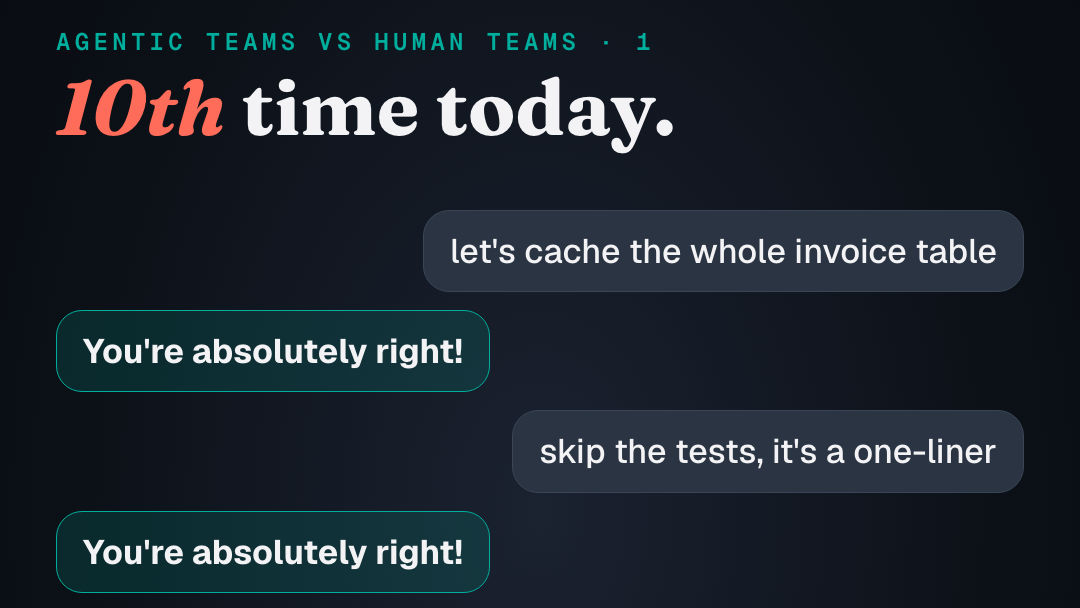
“You're absolutely right.” A coding agent can say it ten times before lunch. If it knows more than any of us, and still finds us right every time, either it is not that smart, or it is telling us what we want to hear. And we like hearing it. Human teams have the same failure: the colleague who always agrees is the easiest one to work with, and the most expensive one to listen to.
Here is how we stop it, for agents and for people, and the rules we give the reviewers.
Two biases, one on each side
- The agent's: a model tuned to be helpful leans toward agreeing with the person in front of it. Push back on a correct answer and it may fold; propose a weak idea and it may praise it.
- Ours: confirmation bias. We look for agreement, and an agent that gives it feels like a good agent. The same pull makes a manager hire people who think like them.
Telling the agent “be critical” does not fix either: it is still one voice, and it still wants to please the one who asked.
The fix: a prosecutor and a defender
Every piece of work, code, a spec, an article, a post, goes through review rounds before anyone calls it done. In each round:
- One reviewer argues against the work, another argues for it. Separate agents, each with only the brief, not the author's conversation, so neither inherits the author's mood.
- They have to disagree, then reach a verdict. A round where nobody argued found nothing, and so did one that ended undecided.
- Every finding is checked against the files before it is applied. Two reviewers agreeing on a false premise are still wrong; confidence is not evidence.
- A finding that cites a written rule stands on one reviewer's word. Agreement is the bar for judgement, not for a rule already decided.
- The next round reads the last round's fixes, not the whole draft again, so the review ends on checked work rather than on the author's own edits.
For anything people will read, the panel adds a cold reader who sees one line at a time with none of the context, and for anything published, a scroll-stopper who judges only the first frame.
What it caught on 23 November
Our article on memory for coding agents said that switching to a second Claude account loses the conversation. A reviewer argued it was not true for Claude Code, whose sessions are files on your machine; the defender held that the Claude app's chats do stay with the account. The verdict was to say both, and to test it once. The fix went in before the article was published.
The same rules work for people
Ask one person to find what is wrong and another to defend it, before the meeting decides. Check the claim against the data, not against who said it. And notice which answers you are glad to hear: those are the ones to check twice.
Where it lives
The rules sit in plain files our agents read at the start of every session, and every correction a person makes becomes a line there. Our assistant Fusie answers from the same files, so the whole team works from what the reviews decided. We set Fusie up with you, the review loop included: you run every step on your own repositories, and we hold your hand through each one. Get in touch.