Article · 23 November 2026
Memory for coding agents: 12 open-source repos, and what we do instead
A coding agent starts every session from zero. The 12 most-starred open-source projects that give it a memory, sorted by the kind of memory each keeps, and how we solved it with plain files.
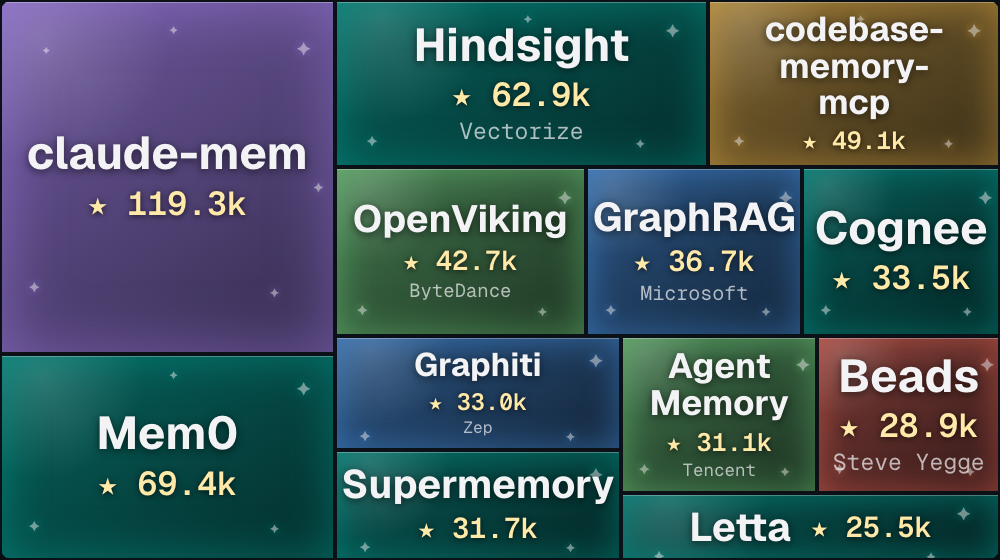
A coding agent starts every session from zero. Yesterday you agreed on the approach, named the files, explained the rule that bit you last week; today it asks again. Below are the 12 most-starred open-source projects that give an agent a memory, sorted by what kind of memory each one keeps; what they do when your plan runs out mid-task and you switch accounts; which of them help an agent get better at its job; and how we solved the same problem ourselves without any of them.
The 12, by GitHub stars
| Project | Stars | What it remembers |
|---|---|---|
| claude-mem | 119,253 | Records what the agent did in each session, compresses it, and feeds the relevant part into the next one. |
| Mem0 | 69,376 | A drop-in memory layer: facts about users and tasks that persist across sessions. |
| Hindsight Vectorize | 62,862 | Agent memory aimed at learning from experience, not only recalling the conversation. |
| codebase-memory-mcp | 49,072 | A persistent local graph of the code, docs and infrastructure, served to the agent over MCP. |
| OpenViking ByteDance | 42,657 | A context database that keeps an agent's memory, knowledge and skills in one place. |
| GraphRAG Microsoft | 36,727 | Builds a knowledge graph from documents, so answers draw on how facts connect. |
| Cognee | 33,509 | Persistent long-term memory for agents, built from your documents and conversations. |
| Graphiti Zep | 33,026 | A knowledge graph that updates in real time as the agent learns new facts. |
| Supermemory | 31,693 | A memory and context engine that can run fully local. |
| Agent Memory Tencent | 31,117 | A team-level memory hub: chats, docs and code turned into memory shared across agents. |
| Beads Steve Yegge | 28,945 | A graph issue tracker for agents, so a long task survives across sessions. |
| Letta the MemGPT team | 25,520 | A platform for stateful agents with memory that grows over time. |
Stars as GitHub reported them on 23 November 2026.
Six kinds of memory
- Past sessions (claude-mem): what the agent did last time, replayed in short. The quickest win when the pain is re-explaining yesterday.
- A memory layer (Mem0, Hindsight, Cognee, Supermemory, Letta): facts the agent stores and recalls through an API. Built for apps with many users as much as for coding.
- A knowledge graph (GraphRAG, Graphiti): facts and how they connect, for questions a flat search answers badly.
- A code map (codebase-memory-mcp): the structure of the repository itself, so the agent stops reading every file to find one.
- Tasks (Beads): the plan and what depends on what, so a task that spans days does not restart each morning.
- Team memory (Tencent's Agent Memory, OpenViking): one memory shared by every agent and every person on the team.
The kinds answer different questions. An agent that forgets yesterday needs the first; an agent that keeps breaking the same rule needs the rules written where it reads them every time; a team whose agents each learn alone needs the last.
The second case: your plan ran out mid-task
You hit your Claude plan's usage limit in the middle of a task, and the limit resets in a few hours. You are smart: you sign in with a second account and carry on. Does the agent still know the discussion, the ideas you threw out, which branch is checked out and why?
In Claude Code, possibly: its sessions are files on your machine, in ~/.claude/projects, and the docs tie resuming one to no account, so claude --resume may pick it up again; try it once before you rely on it. What does not follow you: chats in the Claude app, which sit in the first account's history; the session, once you move to another machine or another tool; and a resumed session is the whole raw conversation, read again from the start, on the new account's limit.
The same repos carry it across, because their memory lives outside any one account, chat or tool:
- claude-mem keeps its memory in
~/.claude-memon your machine, not in your account, so the second account's sessions read what the first one did. - Beads keeps the plan and its open tasks in a repository it can push and pull, so they follow you to another account, or another machine.
- codebase-memory-mcp keeps its map of the code on your machine; any session that connects to it gets the map back.
- Plain files in the repository, the way we do it below: an account that opens the repository reads them like the last one did.
The rule underneath: anything an agent should still know tomorrow has to be written where the next session will look, not left in the chat.
The third case: an agent that gets better at its job
Remembering yesterday is the start. The harder ask is an agent that learns: you correct it once, and the next session, and every colleague's session after it, does it right without being told. Without that, the same correction is typed again every week, by every person on the team.
Three of the 12 aim here. Hindsight is built for agents that learn from experience rather than only recall the conversation. Letta describes agents whose memory can learn and self-improve over time. OpenViking keeps an agent's skills beside its memory, so what it learned to do is kept as well as what it was told.
What none of them decides for you is where a lesson goes and who checks it. A lesson about one task belongs to the instructions for that task; a general one belongs to the rules every session reads; and a lesson that a person wrote down can be reviewed, while one an agent stored for itself usually cannot.
What we do ourselves
We run none of these. Our agents read plain files in the repository at the start of every session: a short file of rules, kept current each time a person corrects the agent; for each area of work, what was decided and why, the ordered backlog, and where it stands; and a file per colleague with how to work with them. Every correction becomes a line in those files, so the next session starts with it.
That is also how ours get better: when someone corrects an agent, the agent rewrites the rule or the skill that should have prevented it, in the same sitting, with the correction quoted beside it, and a person reviews the change like any other. Each repeated job becomes a skill the agent runs the same way every time, and each skill keeps its own lessons.
The same files are our company memory. Our assistant Fusie answers from them, so a person gets the same answer the agent works from, and a lesson one person taught reaches everyone who works in the repository once it is merged. That is the part the 12 above leave to you: what the memory holds and who keeps it true.
See it on our own data: the Knowledge Hub demo answers from a company's memory the way our agents do.
Want the same for your team without picking among twelve repos? We set up Fusie with you, the loop that turns each correction into a rule included: you run every step yourself on your own repositories, and we hold your hand through each one. Get in touch.